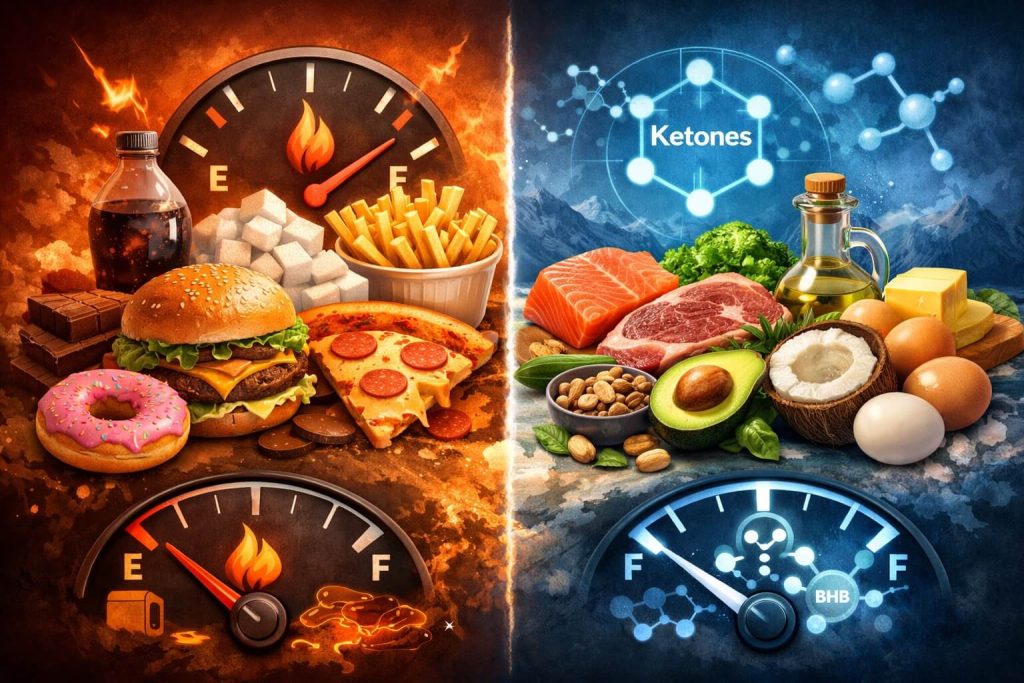
When discussions about diet and weight loss come up, you’ll often hear phrases like “a calorie is a calorie” or “it’s all about calories in versus calories out.” But if you’ve ever wondered whether the source of those calories actually matters, you’re asking one of the most important questions in nutrition—and the answer might surprise you.
Ketosis represents one of the most dramatic examples of why calorie source matters tremendously. When your body switches from burning carbohydrates (glucose) to burning fats (ketones) for energy, it’s not just a minor metabolic tweak. It’s a fundamental transformation that affects virtually every system in your body, from how your brain functions to how hungry you feel, from your energy levels to your mood and stress responses.
Let’s dive deep into understanding ketosis, why switching fuel sources is such a big deal, and why more people aren’t talking about just how significant this metabolic change really is.
What Is Ketosis and How Does It Work?
To understand ketosis, you first need to understand how your body normally gets energy.
Your body’s default fuel: glucose: Under typical eating patterns—consuming carbohydrates from bread, pasta, rice, fruits, and sugars—your body breaks down these carbs into glucose (blood sugar). Glucose is your body’s preferred quick-energy source. It’s what fuels your brain when you’re thinking, your muscles when you’re moving, and even the basic processes like breathing and regulating body temperature.
Your body stores some glucose as glycogen in your liver and muscles—enough for about 24 hours of normal activity. When you eat carbs regularly, you constantly replenish these glycogen stores, and your body happily continues using glucose as its primary fuel.

The metabolic switch: When you drastically reduce carbohydrate intake (typically below 20-50 grams per day) and maintain that reduction for several days, something remarkable happens. Your glycogen stores become depleted, and your body realizes it needs to find an alternative fuel source. This is when it switches to burning fat.
Your liver begins breaking down fatty acids (from both dietary fat and your body’s fat stores) into molecules called ketone bodies. These ketones—primarily beta-hydroxybutyrate, acetoacetate, and acetone—can cross the blood-brain barrier and fuel your brain. They also provide energy for your muscles and other tissues.
This is ketosis: A metabolic state where your body runs primarily on ketones derived from fat rather than glucose derived from carbohydrates. It’s not starvation (though prolonged fasting can trigger it), and it’s not dangerous for most people—it’s simply an alternative metabolic pathway humans evolved to survive periods when carbohydrates weren’t available.
Why Switching Fuel Sources Is a Bigger Deal Than People Realize
Here’s where things get interesting. Switching from glucose to ketones isn’t like switching from regular gasoline to premium in your car. It’s more like converting your car’s engine to run on electricity. The vehicle still moves you from place to place, but the underlying mechanics are fundamentally different.
Your brain on different fuels: Your brain is an energy hog, consuming about 20% of your body’s total energy despite being only 2% of your body weight. On a standard diet, your brain uses about 120 grams of glucose daily.
When you enter ketosis, your brain adapts to run on ketones. This isn’t instantaneous—it takes about 2-4 weeks for full adaptation. During this transition, many people experience “keto flu” with symptoms like brain fog, fatigue, and irritability. But once adapted, many people report enhanced mental clarity, better focus, and more stable cognitive function throughout the day.
Why? Ketones provide a more consistent energy supply than glucose. Glucose levels fluctuate throughout the day based on when and what you eat, creating energy peaks and crashes. Ketones, derived from abundant fat stores, provide steady fuel without the rollercoaster.
Hormone changes: Different fuel sources trigger dramatically different hormonal responses. Carbohydrates trigger insulin release to help cells absorb glucose. Fat and protein trigger much less insulin.
In ketosis, insulin levels stay consistently low. This has cascading effects on other hormones including ghrelin (hunger hormone), leptin (satiety hormone), cortisol (stress hormone), and even neurotransmitters like dopamine and serotonin that affect mood and motivation.
This is why people in ketosis often report reduced hunger and cravings—their hormonal environment has changed, not just their willpower.
Inflammation and cellular function: Glucose metabolism produces more reactive oxygen species (oxidative stress) than fat metabolism. Ketones have been shown to have anti-inflammatory effects and may actually protect cells from oxidative damage.
This shift in inflammation can affect everything from joint pain to skin clarity to mental health. Some people notice reduced inflammation-related symptoms within weeks of entering ketosis.
Neurotransmitter production: Your brain produces neurotransmitters (chemical messengers) differently depending on fuel source. Ketones influence GABA (calming neurotransmitter) and glutamate (excitatory neurotransmitter) production, which can affect anxiety levels, focus, and overall mental state.
This is why some people feel calmer and more focused in ketosis, while others initially feel anxious or restless during the adaptation period.
The Adaptation Period: Why the First Few Weeks Are Rough
If switching fuel sources is so great, why doesn’t everyone do it? One major reason is the adaptation period, which can be genuinely unpleasant.
What happens during keto adaptation: When you first cut carbs and your body starts transitioning to ketones, you’re in a metabolic limbo. Your glycogen stores are depleted, but your body hasn’t yet efficiently ramped up ketone production and cellular machinery to use ketones effectively.
During this 1-3 week period, people commonly experience fatigue and low energy (your body is learning to access fat stores efficiently), brain fog and difficulty concentrating (your brain is adapting to using ketones), irritability and mood changes (neurotransmitter production is shifting), headaches (often related to electrolyte imbalances), muscle cramps (sodium, potassium, and magnesium depletion), and digestive changes (gut bacteria population is adjusting to different fuel).
This “keto flu” is temporary, but it’s unpleasant enough that many people quit before they become fully adapted and experience the potential benefits.
Why you need to stick with it: The crucial thing to understand is that these symptoms don’t mean ketosis is bad for you—they mean your body is adapting to a fundamentally different metabolic state. It’s like the soreness you experience when starting a new workout routine. Your body needs time to build the cellular machinery to efficiently produce, transport, and utilize ketones.
Most people who push through the 2-4 week adaptation period report that energy levels, mental clarity, and overall well-being improve dramatically compared to their initial glucose-burning state.
Beyond Weight Loss: The Full-Body Impact of Fuel Source
Most people think of ketosis only in terms of weight loss, but the metabolic shift affects far more than just fat burning.

Energy stability: On a glucose-based diet, energy levels typically fluctuate throughout the day. You might feel energized after meals but experience crashes 2-3 hours later as blood sugar drops, prompting you to eat again.
In ketosis, because your body can access vast fat stores at any time, energy tends to be more stable throughout the day. Many people report no longer experiencing the afternoon energy slump or needing frequent snacks.
Appetite and hunger: Ketones themselves appear to have appetite-suppressing effects. Additionally, the stable blood sugar and insulin levels mean you don’t experience the hunger spikes that come with glucose fluctuations.
This is why many people in ketosis naturally eat less without feeling deprived—they’re simply not as hungry. This isn’t about willpower; it’s about different hormonal signaling.
Mental performance: While the research is still evolving, many people report improved focus, concentration, and mental endurance in ketosis. Some theories suggest that ketones provide more efficient fuel for brain cells, or that the reduced inflammation benefits cognitive function.
Interestingly, ketogenic diets were originally developed in the 1920s to treat epilepsy in children, and they’re still used for that purpose today. This demonstrates that fuel source definitely affects brain function in measurable ways.
Physical performance: The impact on athletic performance is more nuanced. For high-intensity, short-duration activities (sprinting, weightlifting, high-intensity interval training), glucose remains superior because it can be metabolized more quickly for immediate energy.
However, for endurance activities (long-distance running, cycling, ultra-marathons), fat-adapted athletes often perform as well or better than carb-fueled athletes because they can access virtually unlimited energy from fat stores rather than being limited by glycogen depletion.
Mood and stress: Many people report feeling calmer and more emotionally stable in ketosis. Some research suggests ketones may have mood-stabilizing effects, and the elimination of blood sugar crashes certainly helps prevent the irritability that comes with hunger and energy dips.
However, some people experience increased anxiety or emotional sensitivity during the adaptation period or even long-term. Individual responses vary significantly.
Why Don’t More People Talk About How Significant This Change Is?
If switching fuel sources has such profound effects, why isn’t this talked about more widely?
It challenges conventional nutrition wisdom: For decades, mainstream nutrition guidance has emphasized carbohydrates as the foundation of a healthy diet. Acknowledging that humans can thrive—and potentially feel better—running on fat instead of carbs challenges established dietary guidelines and the professionals who built their careers around them.
Individual variation is huge: Not everyone responds to ketosis the same way. Some people feel amazing, experience dramatic improvements in energy and mental clarity, and never want to go back. Others feel terrible even after the adaptation period and function better on carbs. This variability makes it hard to make broad statements about whether ketosis is “good” or “bad.”
It’s genuinely difficult: Maintaining true ketosis requires strict carbohydrate restriction—typically under 20-50 grams daily. That’s roughly one medium apple or a single slice of bread. In a food environment filled with carbs, this level of restriction is challenging for most people to maintain long-term.
The adaptation period turns people off: Many people try keto, feel terrible for a week or two, and quit before becoming adapted. They then spread the message that “keto made me feel awful,” without realizing they quit right before the potential benefits would have appeared.
Incomplete research: While research on ketogenic diets is expanding, we still don’t have comprehensive long-term studies on all the effects. Scientists are conservative about making claims without extensive evidence, which means the full picture isn’t yet widely disseminated.
Economic interests: The food industry makes enormous profits from processed carbohydrates. There’s not much financial incentive to promote dietary approaches that eliminate entire categories of profitable products.
Does Calorie Source Matter or Is It Just About Calories?
So, back to the original question: does the source of calories matter, or is it really just about total calories?
The truth is both matter, but in different ways.
For pure weight loss, calories are indeed the primary driver. Whether you eat 2,000 calories of carbs or 2,000 calories of fat, if you maintain a caloric deficit, you’ll lose weight. The fundamental law of thermodynamics—energy in versus energy out—still applies.
However, calorie source profoundly affects:
- How hungry you feel (affecting how easy it is to maintain that caloric deficit)
- Your energy levels throughout the day
- Your hormonal environment
- How much muscle versus fat you lose
- Your mental clarity and focus
- Your mood and stress resilience
- Your athletic performance in various activities
- Your risk factors for certain diseases
- How sustainable the diet feels long-term
Two people eating the same number of calories from different sources will have dramatically different experiences, even if they lose similar amounts of weight.
The practical implication: If you’re someone who struggles with constant hunger, energy crashes, mental fog, or mood swings on a standard carb-based diet, switching fuel sources to ketosis might address those issues in ways that simply eating fewer carb-calories wouldn’t.
Conversely, if you feel great on carbs, perform well athletically, and have no energy or hunger issues, there may be no compelling reason to switch fuels.
Who Might Benefit from Understanding Fuel Sources?
Understanding how different fuel sources affect your body is valuable for several groups:
People struggling with constant hunger: If you’re always hungry on a calorie-restricted diet, ketosis might help by changing your hormonal hunger signals.
Those with energy fluctuations: If you experience significant energy crashes throughout the day, stable ketone-based fuel might provide more consistent energy.
Individuals with insulin resistance or prediabetes: Lower-carb approaches that promote ketosis can improve insulin sensitivity and blood sugar control.
People seeking mental clarity: Some individuals find cognitive benefits from ketone-based brain fuel.
Endurance athletes: Once adapted, fat-based fuel can support prolonged physical activity without needing frequent refueling.
Those with certain neurological conditions: Ketogenic diets are used therapeutically for epilepsy and are being researched for other neurological conditions.
The Bottom Line: Fuel Source Matters Immensely
To answer the original question: yes, the source of your calories matters enormously, and ketosis is a perfect example of why.
Switching from glucose to ketones as your primary fuel isn’t just a different way to create energy—it’s a fundamental metabolic transformation that affects virtually every system in your body. Your brain chemistry changes, your hormones shift, your hunger signals alter, your energy patterns stabilize, and even your gut bacteria population transforms.
This isn’t to say everyone should be in ketosis. Many people function perfectly well—even optimally—on carbohydrate-based metabolism. The point is that fuel source creates significantly different metabolic states with different effects on how you feel, perform, and function.
The reason this isn’t talked about more widely is a combination of factors: it challenges conventional wisdom, individual responses vary dramatically, it’s difficult to maintain, and we’re still learning about all the long-term effects.
But for those willing to go through the adaptation period and maintain the dietary restrictions, switching fuel sources can be a powerful tool for optimizing energy, mental clarity, hunger control, and overall well-being—far beyond just changing the number of calories consumed.
Understanding that your body can run on fundamentally different fuel sources, each with its own set of effects, empowers you to make informed choices about which metabolic state serves your individual goals, lifestyle, and biology best.