The pattern repeats itself with disappointing regularity. You create an elaborate tracking system, fill it out enthusiastically for a week or two, then abandon it as the effort outweighs any insight gained. Spreadsheets pile up with meticulous records of workouts, meals, and sleep hours, yet somehow you still can’t answer the simple question of whether you’re actually doing well. The problem isn’t your commitment or discipline. It’s that most wellness tracking focuses on inputs and behaviors while ignoring the outcomes that actually matter. You can exercise daily, eat perfectly, and sleep eight hours while still feeling terrible. The disconnect between tracking actions and measuring actual wellbeing leaves you with data that doesn’t tell you what you really need to know.
Why do wellness tracking systems usually fail?
The initial enthusiasm for tracking comes from the hope that measurement will create clarity and motivation. Creating the system feels productive and gives you a sense of control over your health. However, the daily reality of data entry quickly reveals that most tracking systems demand more effort than they justify through useful insights. The friction of remembering to track, finding the spreadsheet, and entering data creates resistance that accumulates until you abandon the entire project.
Traditional wellness tracking focuses on quantifiable behaviors because they’re easy to measure, not because they’re most meaningful. Steps, calories, workout duration, and hours of sleep all translate neatly into numbers and graphs. This measurability makes them appealing for tracking systems but doesn’t mean they accurately represent wellness. The ease of measurement doesn’t correlate with importance or relevance to how you actually feel.
The gap between behavior tracking and outcome measurement creates the disconnect you’ve identified. You can faithfully record every action while remaining completely disconnected from whether those actions are improving your wellbeing. The spreadsheet tells you what you did but not how you feel, how you’re functioning, or whether your life is actually better. This fundamental flaw undermines the entire purpose of tracking.
Inconsistent tracking creates guilt rather than insight. Missing a day or week of data entry transforms the tracking system from a tool into a source of stress. The incomplete data loses its value for pattern recognition, yet you feel guilty about the abandonment. This guilt makes resuming tracking feel like admitting failure rather than simply adjusting your approach.
The complexity of most tracking systems contributes to their demise. Tracking five or ten different metrics daily creates significant time burden and decision fatigue. Which metrics matter most today? Did you record everything? The mental load of maintaining complex tracking eventually becomes another stressor rather than a helpful tool.
What’s the difference between tracking behaviors and tracking wellness outcomes?
Behavior tracking records what you do including exercise frequency, food choices, supplement intake, or meditation practice. These metrics reflect your actions and habits. Outcome tracking measures how you feel, how well you function, and whether your life quality is improving. These reflect the actual results of your behaviors and circumstances.
The relationship between behaviors and outcomes isn’t always straightforward or predictable. Someone might exercise intensely every day yet feel increasingly exhausted and irritable because they’re overtraining. Another person might have imperfect nutrition but feel energetic and satisfied. Tracking only behaviors misses the crucial feedback about whether those behaviors are actually serving you.
Outcome-based tracking asks fundamentally different questions than behavior tracking. Instead of “Did I exercise today?” it asks “Do I have energy for the activities I care about?” Instead of “How many hours did I sleep?” it asks “Do I wake up feeling rested?” This shift in focus moves from external compliance to internal assessment of actual wellbeing.
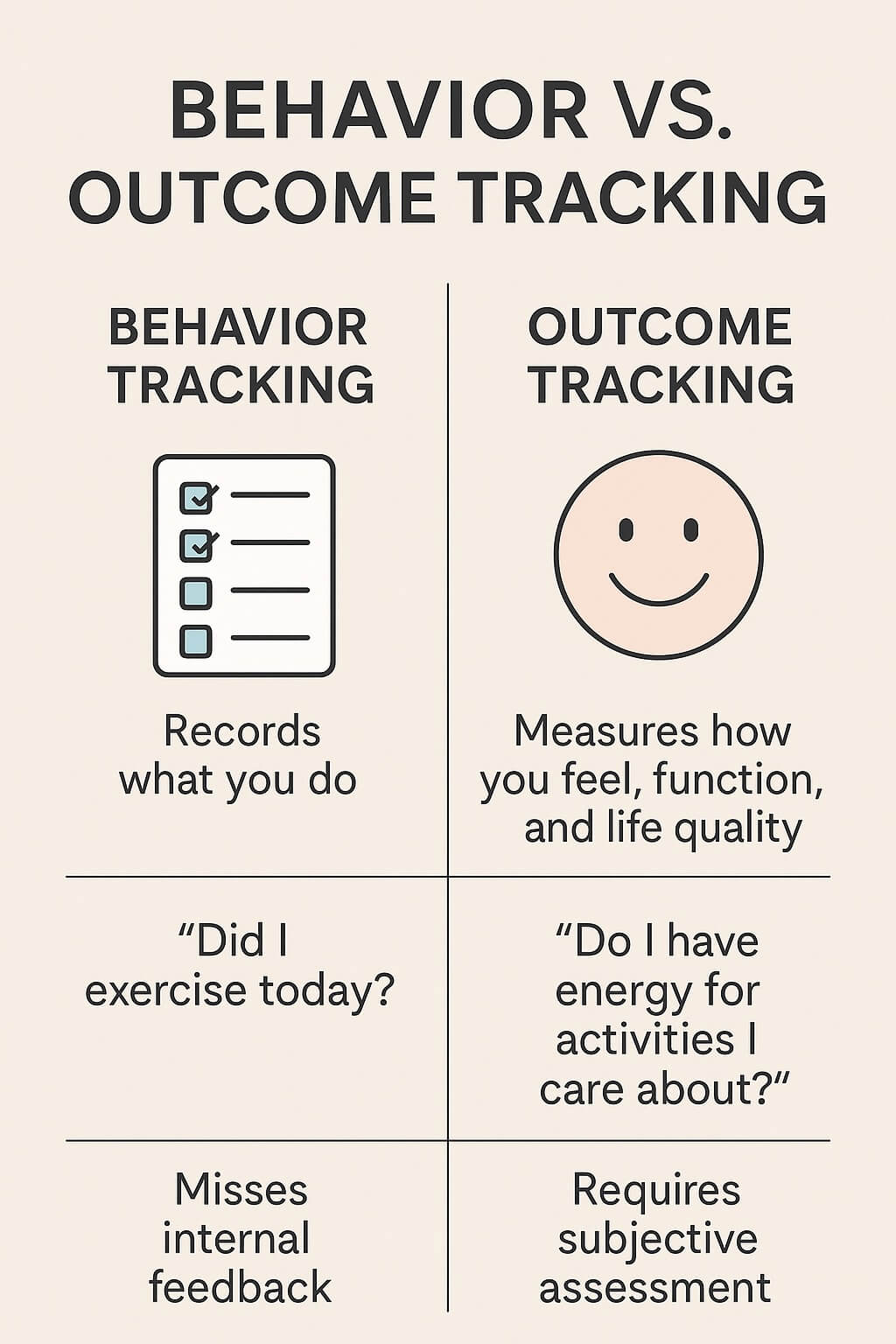
The challenge with outcome tracking is that it requires more subjective assessment and self-awareness. There’s no device that measures your mental clarity or sense of life satisfaction. You must tune into your internal experience and make judgments about states that don’t translate neatly into numbers. This subjectivity makes people uncomfortable despite being more relevant than objective behavior counts.
Integrating both behavior and outcome tracking provides the most useful information. Behaviors offer potential explanations for outcome patterns. If your energy crashes, looking at recent behavior might reveal you’ve been sleeping poorly or skipping meals. However, the behaviors only matter if they connect to outcomes you care about. The outcomes provide the essential feedback that makes behavior data meaningful.
How can you track wellness without creating another chore?
Reducing tracking frequency dramatically decreases the burden while often preserving useful insights. Daily tracking creates significant overhead that weekly or even monthly check-ins can avoid. Most wellness patterns show up over weeks rather than days anyway. A brief weekly reflection captures trends without the exhausting daily data entry.
Integrating tracking into existing routines eliminates the need to remember and create separate time for it. If you already journal, adding a wellness reflection requires no additional habit formation. If you already review your calendar weekly, adding a quick wellness assessment fits naturally. The key is attaching tracking to established behaviors rather than creating new obligations.
Using simple rating scales instead of detailed metrics reduces both time and cognitive load. A single question like “How would I rate my overall wellness this week on a scale of one to ten?” takes seconds to answer and creates data points that reveal patterns over time. You can always add context about why you rated it that way without the burden of tracking multiple variables.
Voice notes or brief written reflections often capture wellness better than quantitative tracking. Speaking or writing for two minutes about how you’re feeling, what’s working, and what’s challenging provides rich qualitative data. Reviewing these reflections monthly reveals patterns and changes that numbers alone miss. The unstructured format also reduces the resistance that comes with filling out forms.
Focusing on the smallest viable tracking system that provides useful feedback prevents the creep toward complexity. Start with literally one question answered once weekly. If that proves valuable and sustainable, you can always add more. Most people do the opposite, starting with ambitious comprehensive systems they can’t maintain. Minimal tracking that actually happens beats comprehensive tracking that gets abandoned.
What wellness outcomes actually matter to track?
Energy levels throughout the day provide fundamental wellness feedback that connects to many underlying factors. Consistent energy suggests your sleep, nutrition, stress management, and activity levels are in reasonable balance. Patterns of crashes, persistent fatigue, or wired-but-tired feelings all signal specific issues worth investigating. Energy is also immediately perceivable without requiring special assessment.
Mood stability and emotional wellbeing reflect your psychological health more directly than any behavior metric. Are you generally content or frequently irritable? Do emotions feel manageable or overwhelming? Is your baseline mood positive, neutral, or negative? These subjective experiences constitute a huge portion of wellness yet get ignored in favor of tracking steps or calories.
Sleep quality differs significantly from sleep quantity and better predicts how you’ll actually feel. You can sleep eight hours and wake exhausted or sleep six hours and wake refreshed. Tracking whether you feel rested matters more than tracking hours in bed. The quality reflects the complex interaction of stress, circadian rhythms, sleep disorders, and environmental factors.
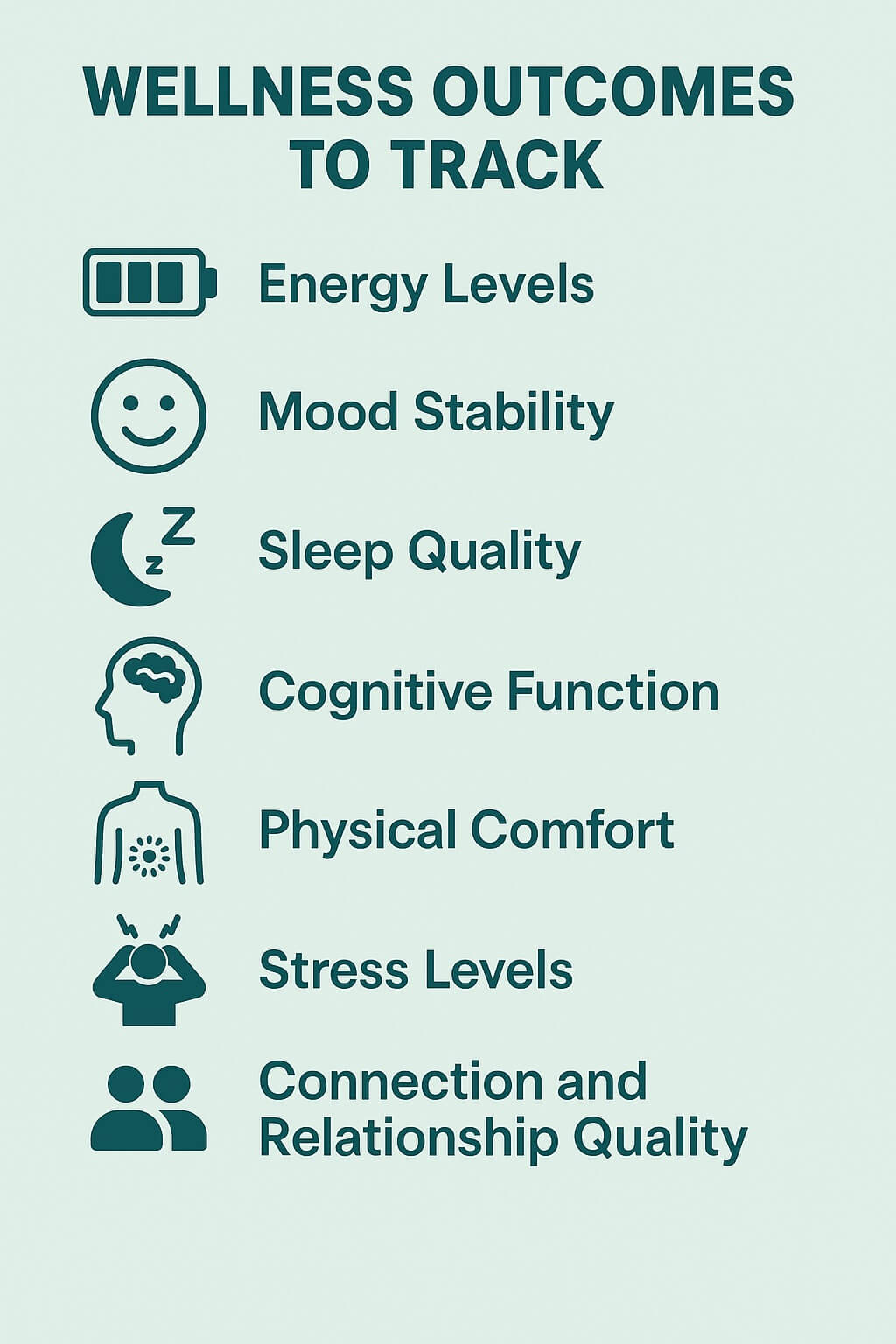
Cognitive function including mental clarity, focus, and decision-making capability indicates how well your brain is functioning. Brain fog, difficulty concentrating, or feeling mentally sluggish all signal problems even when other metrics look fine. Your cognitive state affects every aspect of life and deserves explicit attention in wellness assessment.
Physical comfort or discomfort provides important feedback about how your body is doing. Persistent pain, tension, digestive issues, or other physical symptoms tell you something needs attention. Conversely, feeling physically comfortable and capable suggests your body is functioning well. This seems obvious yet often goes untracked because it’s not easily quantified.
Stress levels and your capacity to handle challenges reflect your overall resilience and wellbeing. Do daily demands feel manageable or overwhelming? Can you handle unexpected problems with relative equanimity or do small issues send you spiraling? Your stress response and coping capacity indicate wellness more meaningfully than knowing you meditated for ten minutes.
Connection and relationship quality significantly impact wellness but rarely appear in tracking systems. Do you feel connected to others or isolated? Are your interactions mostly positive or draining? Human connection is a fundamental wellness determinant that deserves assessment alongside physical health markers.
How do you track subjective experiences without making them meaningless?
Using consistent language and reference points makes subjective ratings comparable over time. If you rate your energy as a seven this week, you need some shared understanding of what seven means to compare with next week’s rating. Creating personal anchors helps. A seven might mean “enough energy for work and some evening activity but not much extra.” These anchors don’t need to be written down, just internally consistent.
Accepting that perfect objectivity isn’t the goal frees you to capture genuinely important information. Some wellness aspects are inherently subjective. Trying to make them objective through elaborate metrics often removes what makes them meaningful. Your sense of whether life is going well matters more than achieving false precision through numbers.
Tracking relative changes rather than absolute levels often provides the most useful information. Instead of trying to objectively define your energy level, notice whether it’s better, worse, or about the same as recent weeks. The direction and magnitude of change matters more than the absolute rating. This approach reduces the burden of achieving calibrated measurements.
Adding brief context to ratings creates the qualitative richness that makes subjective data useful. If you rate your wellness as a four this week, adding “felt overwhelmed at work and barely slept” transforms that number into actionable information. The context explains the rating and suggests what might help improve it.
Noticing patterns across multiple subjective measures builds confidence in the assessment. If your energy is low, your mood is poor, and your stress feels high all at the same time, that convergence suggests you’re genuinely struggling rather than just having random measurement error. Multiple subjective indicators pointing the same direction create more reliable information than any single metric.
What’s a realistic wellness tracking system someone will actually use?
A sustainable tracking system typically involves answering just a few key questions at regular intervals rather than daily comprehensive logs. Weekly reflection works better than daily tracking for most people. The questions might be as simple as: “How was my overall wellbeing this week?” “What went well?” “What challenged me?” These three questions create valuable tracking with minimal burden.
The actual mechanism matters less than the fit with your life and preferences. Some people prefer writing in a journal, others want to use their phone, some like voice memos, and others prefer physical forms. The best system uses whatever method you’ll actually engage with consistently. Fighting your natural preferences to use a theoretically optimal system guarantees abandonment.
Building in regular review times transforms scattered data points into useful insights. Monthly reviewing your weekly check-ins reveals patterns you can’t see from any single entry. Quarterly reviewing the monthly patterns shows longer-term trends. Without this review practice, even the best tracking data just accumulates without generating the understanding that makes it worthwhile.
Keeping the barrier to entry extremely low prevents the system from becoming another source of stress. If accessing your tracking system requires opening a specific app, navigating menus, and filling out forms, you probably won’t do it consistently. If it means grabbing whatever notebook is nearby and jotting a few sentences, you’re much more likely to maintain it.
Allowing imperfect tracking without guilt makes the system sustainable. Missing a week doesn’t ruin the value of the system or mean you’ve failed. You just pick up again without drama. The tracking exists to serve you, not to create another obligation you must fulfill perfectly. This mental shift from tracking as requirement to tracking as optional tool changes the entire dynamic.
How do you know what’s worth tracking versus what’s just noise?
Start by identifying what you actually want to know about your wellness rather than tracking what seems like you should track. Do you want to understand your energy patterns? Your mood stability? Your stress resilience? Your physical health? Getting clear on your actual questions helps you identify relevant metrics rather than tracking everything available.
Track something only if you plan to use the information to make decisions or changes. If you’re tracking a metric but never looking at the data or adjusting anything based on it, you’re wasting effort. Useful tracking informs action. Data that just accumulates without influencing anything is noise regardless of how precisely it’s measured.
Eliminate metrics that show little variation or that you can’t interpret meaningfully. If something stays relatively constant or if changes don’t tell you anything useful, stop tracking it. Your weight might be important for some people but meaningless noise for others. The relevance depends on your specific wellness goals and challenges.
Notice what you find yourself thinking about or wondering about regarding your wellness. If you frequently wonder “Why am I so tired lately?” then energy tracking might be valuable. If you never think about your nutrition but constantly wonder why your mood fluctuates, maybe track mood instead of meals. Your natural curiosity points toward what matters for you specifically.
Test tracking something for a defined period to see if it provides valuable insights, then consciously decide whether to continue. Try tracking a specific metric for a month. At the end, ask yourself what you learned and whether that information was worth the effort. This experimental approach prevents indefinite tracking of things that don’t actually help you.
Can you track wellness without becoming obsessive about it?
The line between helpful tracking and obsessive monitoring depends partly on how the tracking makes you feel. Helpful tracking creates clarity and empowerment. You check in periodically, notice patterns, make adjustments, and feel more in control of your wellbeing. Obsessive tracking generates anxiety, constant preoccupation, and diminishing returns as you track more and more variables seeking perfect optimization.
Setting clear boundaries around tracking frequency and scope prevents the slide into obsession. Decide in advance that you’ll check in weekly, not daily. Limit yourself to three or four key metrics rather than trying to track everything. These boundaries create structure that supports healthy tracking while preventing it from consuming disproportionate time and mental energy.
Remembering that wellbeing is meant to be lived, not just monitored, helps maintain perspective. The goal is to feel good and live well, not to generate perfect data. If tracking interferes with actually living, it’s counterproductive regardless of how comprehensive or accurate it becomes. The tracking should support your life, not become your life.
Using tracking for exploration rather than judgment changes the relationship with your data. Approach your wellness patterns with curiosity about what you might learn rather than using data to criticize yourself for not doing enough. The tracking exists to increase understanding and guide decisions, not to provide ammunition for self-criticism.
Taking breaks from tracking periodically prevents burnout and provides perspective. Stop tracking entirely for a month or two. Notice whether you feel more relaxed or whether you miss the clarity it provided. This experimentation helps you find the right balance of tracking versus living without constant monitoring.
What role should technology play in wellness tracking?
Technology offers convenience for capturing and reviewing data but also introduces complications. Automated tracking from wearables eliminates the burden of manual data entry but often focuses on easily measured behaviors rather than meaningful outcomes. Apps provide structure and reminders but require learning interfaces and risk over-complicating simple reflections.
The decision to use technology should be based on whether it genuinely makes tracking easier and more sustainable for you specifically. Some people love having everything in one app with graphs and analytics. Others find that technology creates more friction than simply writing in a notebook. Neither approach is inherently better. The question is which one you’ll actually maintain.
Passive automated tracking from devices creates data without requiring active engagement but often drowns you in information that doesn’t translate to understanding. Your fitness tracker knows your steps, heart rate variability, and sleep stages. But does that information help you make better decisions or does it just create data overload? The abundance of automatic data often provides less insight than a single thoughtful reflection.
Using technology for storage and review while keeping capture simple often provides the best balance. You might record voice memos about your wellness that get saved automatically, then review them monthly. Or you might snap photos of handwritten journal entries stored in the cloud. This hybrid approach uses technology’s strengths without requiring you to interact with apps constantly.
The risk of technology dependence means considering what happens if the app shuts down, your device breaks, or you want to switch systems. Data locked in proprietary formats or dependent on specific platforms creates vulnerability. Simple, exportable formats or physical records avoid these complications while potentially being less convenient.
How can you track wellness when symptoms and patterns are complex?
Complex health situations benefit from tracking relationships between variables rather than just logging individual metrics. If you have multiple symptoms or conditions, noting what happens together provides more insight than isolated measurements. Perhaps your energy crashes correlate with poor sleep, but only when you also skipped meals. These multi-variable patterns are hard to see without tracking.
Using narrative tracking alongside any quantitative metrics captures complexity that numbers alone miss. A brief written reflection about how you’re doing, what you’re experiencing, and what seems connected provides context that makes sense of otherwise confusing data. The story of your wellness contains information that spreadsheets can’t capture.
Accepting that you might not immediately understand patterns encourages patience with the tracking process. Complex patterns can take months to become visible. The investment in consistent tracking pays off when you finally notice that your migraines always follow several days of high stress plus poor sleep plus specific foods. These multi-factor patterns only emerge through sustained observation.
Working with healthcare providers to identify what’s worth tracking makes the effort more purposeful. If your doctor wants to understand your pain patterns, tracking pain levels with contextual notes serves a clear purpose. If your therapist is helping you understand mood patterns, tracking mood with life events makes sense. Purpose-driven tracking feels more meaningful than just tracking everything speculatively.
Distinguishing between tracking for understanding versus tracking for diagnosis or treatment avoids overstepping what self-monitoring can accomplish. Tracking can help you notice patterns and communicate better with providers, but it can’t replace professional assessment. Being clear about this boundary prevents tracking from becoming anxiety-provoking amateur diagnosis.
What if the act of tracking changes your behavior?
The observer effect in wellness tracking is real and can be both positive and negative. Knowing you’ll track something often changes how you engage with it. This isn’t necessarily bad. If tracking your evening routine helps you be more intentional about winding down, that’s a positive effect. The problem arises when you start performing for the tracking system rather than living authentically.
Tracking changing your behavior becomes problematic when you make choices based on how they’ll look in your log rather than what actually serves you. Skipping a needed rest day because you want to log a workout, or forcing yourself to meditate when you really need to move, both represent the tracking system overriding your genuine needs.
Building in reflection about whether tracked behaviors still serve you prevents autopilot continuation of things that stopped being helpful. Just because you’ve been tracking daily meditation for six months doesn’t mean you must continue if it no longer feels valuable. Regularly questioning whether tracked behaviors align with current needs keeps the system relevant.
Remembering that the map is not the territory helps maintain perspective. Your tracking system represents your wellness but is not your wellness itself. The numbers and notes are abstractions of lived experience. Don’t confuse having good tracking data with actually being well. You could have a perfect tracking log while struggling significantly if you’re tracking the wrong things or manipulating behaviors to look good on paper.
Focusing primarily on outcome tracking rather than behavior tracking reduces the risk of performative changes. If you track how you feel rather than just what you do, it’s harder to game the system. Your energy levels and mood respond to your actual circumstances, not to whether you logged the “right” behaviors.
How often should you review your wellness tracking data?
Review frequency depends on the patterns you’re trying to understand and the pace of change in your life. Daily review is usually unnecessary and can promote obsession. Weekly review allows you to notice immediate patterns and make tactical adjustments. Monthly review reveals bigger trends that weekly snapshots miss. Quarterly or annual review shows long-term trajectories and major life changes.
Creating a regular review practice transforms random data points into actionable insights. Set a specific time like Sunday evening or the first day of each month to look at your recent tracking. During this review, ask what patterns you notice, what surprises you, and what you might want to adjust. Without this structured reflection, even diligent tracking provides little value.
The review itself matters more than the tracking volume. One weekly check-in that you actually review monthly provides more value than daily tracking that never gets examined. The synthesis of information through reflection creates understanding that raw data alone can’t provide. Prioritize review over accumulating more data.
Using different lenses for different review periods adds depth to understanding. Weekly reviews might focus on immediate adjustments like “I’m exhausted, maybe I need more sleep this week.” Monthly reviews can identify patterns like “Every time I skip workouts for a week, my mood drops significantly.” Quarterly reviews reveal even longer patterns like “My wellness always declines in winter, I should prepare for that.”
Being willing to abandon patterns that aren’t useful prevents perpetual tracking without purpose. If you review monthly and realize that tracking a particular metric hasn’t told you anything useful in three months, stop tracking it. Your review practice should include evaluating the tracking system itself and adjusting what you measure based on what actually proves informative.
What does wellness tracking look like for someone with limited time or energy?
Minimal viable tracking for time-constrained people might be a single weekly question: “How was my week overall?” answered with a number and one sentence of context. This takes literally one minute and still creates data points that reveal patterns over time. You can always elaborate when you have more time or energy, but this baseline captures essential information.
Using transition moments that already exist in your schedule eliminates the need to create dedicated tracking time. The few minutes between waking and getting out of bed might be when you mentally note how you slept. The commute home from work might be when you reflect on your energy level. These stolen moments add up to meaningful tracking without requiring additional time blocks.
Batch processing tracking by doing weekly or monthly reflections all at once reduces the overhead of daily engagement. Spend fifteen minutes on Sunday reflecting on the entire previous week rather than spending a minute each day. For some people, this concentrated reflection is easier to maintain than distributed daily tracking.
Accepting that imperfect tracking beats no tracking releases you from perfectionist paralysis. You’ll forget some weeks. Some entries will be brief or vague. The tracking will have gaps. All of this is fine. Imperfect information about your wellness patterns still exceeds having no information while demanding less time and energy than trying to track perfectly.
Recognizing that rest periods from tracking might be necessary rather than failure acknowledges that everything in life has seasons. When you’re barely functioning, adding tracking might be too much. When you’re doing well, tracking might feel unnecessary. Both situations are valid reasons to pause tracking. You can always resume when the timing is better.
How can tracking help identify what actually improves your wellness?
Tracking before and after making changes creates the data needed to assess whether changes actually help. If you start a new sleep routine, tracking your sleep quality and daytime energy before and after shows whether it worked for you specifically. Without tracking, you’re relying on vague impressions that might miss real improvements or falsely attribute benefits to ineffective changes.
The ability to test one change at a time becomes possible with consistent tracking. If you simultaneously start exercising, change your diet, and begin meditation, you can’t know which intervention helped. Tracking while making isolated changes allows you to identify what specifically moves your wellness needle. This experimentation requires patience but leads to genuine understanding.
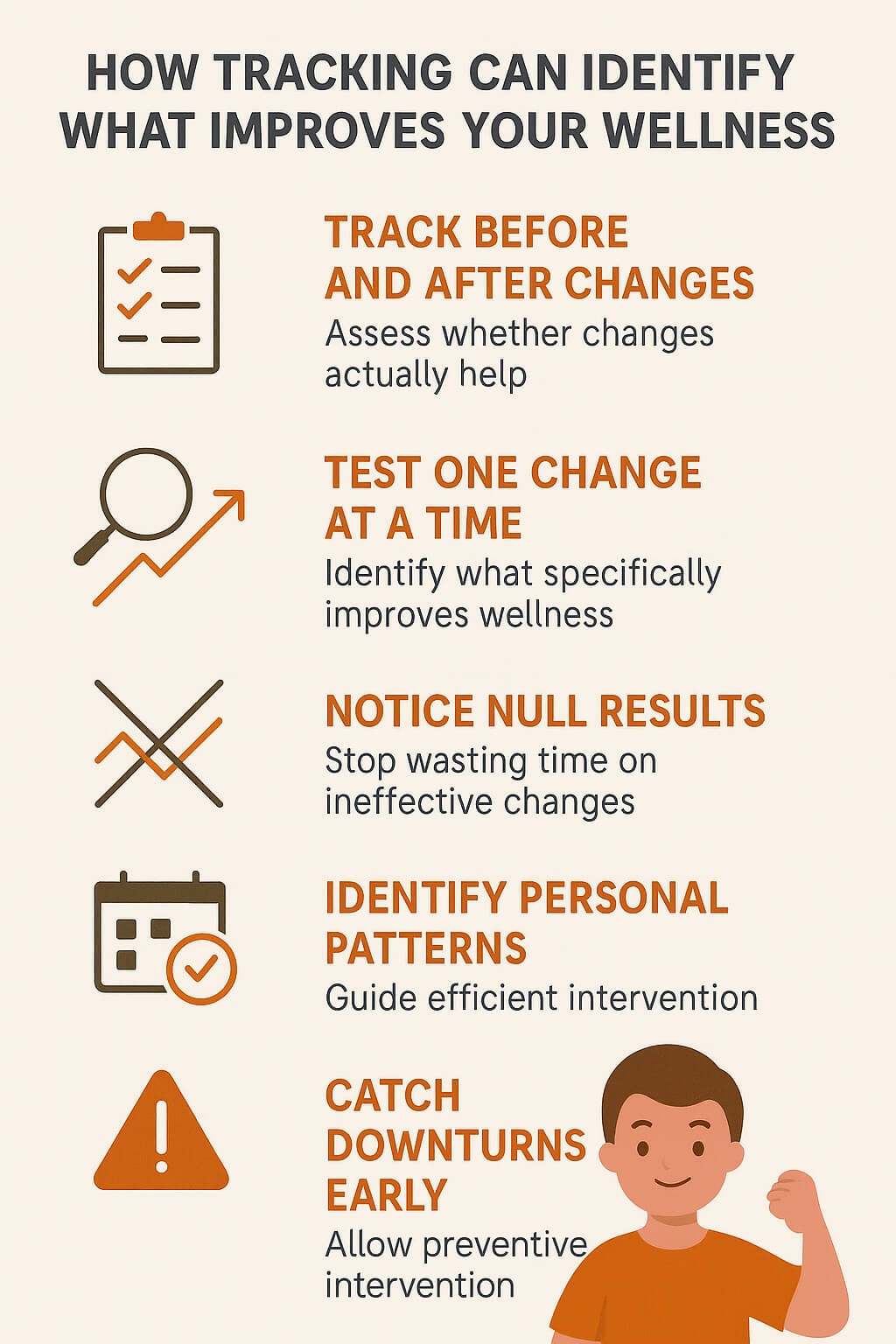
Noticing null results is as valuable as noticing improvements. If you’ve been faithfully doing something that wellness culture says should help but your tracking shows no improvement, you can stop wasting time on it. Many wellness recommendations are presented as universal truths but work differently for different people. Your tracking data reveals what actually works for you rather than what should theoretically work.
Identifying your personal wellness patterns guides efficient intervention. Maybe your tracking reveals that your energy always crashes midweek, or that your mood deteriorates specifically when you have back-to-back stressful meetings, or that you sleep poorly during certain phases of your cycle. These patterns suggest targeted interventions rather than generic wellness advice.
Using tracking to catch downturns early allows preventive intervention before full crises develop. When you know your patterns, you can recognize the early warning signs of declining wellness and act before hitting rock bottom. Perhaps you notice that skipping self-care for three days always predicts a crash by day five. With that knowledge, you can intervene on day three rather than suffering through the preventable crash.
What if tracking reveals concerning patterns you don’t know how to address?
Tracking sometimes uncovers patterns that need professional attention rather than self-help solutions. Persistent sleep problems, chronic pain, prolonged low mood, or other concerning patterns might indicate medical or mental health conditions requiring proper diagnosis and treatment. In these cases, the tracking serves its purpose by revealing the need for professional help rather than providing DIY solutions.
Using your tracking data to communicate more effectively with healthcare providers makes appointments more productive. Instead of vague reports that “things aren’t good,” you can show specific patterns including when problems occur, what seems to help or worsen them, and how long they’ve persisted. This concrete information helps providers make better assessments and recommendations.
Accepting that awareness without immediate solutions is still valuable prevents tracking from feeling frustrating or futile. Sometimes knowing your patterns is the first step even if you don’t immediately know what to do about them. The awareness itself often leads to eventual insights or solutions as you live with and think about the patterns.
Sharing your observations with trusted friends or communities can surface ideas and resources you hadn’t considered. Others who’ve experienced similar patterns might offer suggestions based on what worked for them. These aren’t substitutes for professional help when needed, but they expand your possibilities for addressing what you’ve noticed.
Remembering that some patterns reflect circumstances rather than personal failure removes unhelpful self-blame. If your tracking shows you’re perpetually stressed and exhausted, maybe that reveals that your job is unsustainable or your living situation is problematic. The tracking points toward external changes needed rather than just personal wellness optimization.